

Can You See the Tokyo Imperial Palace? What You Can Actually Visit
Yes, you can visit parts of Tokyo's Imperial Palace grounds. Here is how to distinguish the public gardens, famous bridge views, official tour and Emperor's private residence.
Affiliate disclosure: Some links in this article may earn Japan Trip Planners a commission at no extra cost to you. Recommendations are included when they are genuinely useful for planning, and you should still compare current prices, terms, and official provider information before booking.
Yes, you can see parts of the Tokyo Imperial Palace
Yes, you can see and photograph parts of the Tokyo Imperial Palace area. The confusion comes from treating a large complex as if it were one building with a single public entrance. The grounds contain surviving features of Edo Castle, public gardens, buildings used for official duties, and the Emperor's private residence. These do not all have the same access rules.
For an ordinary visitor, the most accessible sights are the moats, stone walls, historic gates and watchtowers, the famous bridge viewpoint, and the Imperial Palace East Gardens. An official guided tour provides a different, controlled route through part of the grounds, including views of ceremonial palace buildings. It is not a tour of the Emperor's home.
There are real photographs of the palace complex. That does not mean visitors can walk up to the private residence or photograph it from the public gardens. The residence is within secured, off-limits grounds, away from ordinary public viewpoints.
Which part should you visit?
Start with the experience you want, not just the label Imperial Palace on a map. A photo stop, a garden walk and an official tour are different plans. The following time estimates are our planning allowances, not official visit lengths or guaranteed entry windows.
- For the recognizable moat-and-bridge view: choose the public Kokyo Gaien side near the Main Gate. Allow roughly 45-60 minutes for an exterior walk and photographs, plus transport.
- For gardens and Edo Castle remains: choose the East Gardens. Allow roughly 90 minutes to two hours for an unhurried visit, depending on your route and walking pace.
- For a closer look at part of the official palace grounds: apply for the free guided tour. The scheduled tour lasts approximately 75 minutes; registration, security and travel require additional time.
- For the Emperor's private home or palace interiors: these are not part of a normal public sightseeing visit. Do not book a tour expecting access to residential rooms.
What are you seeing in the famous Imperial Palace photos?
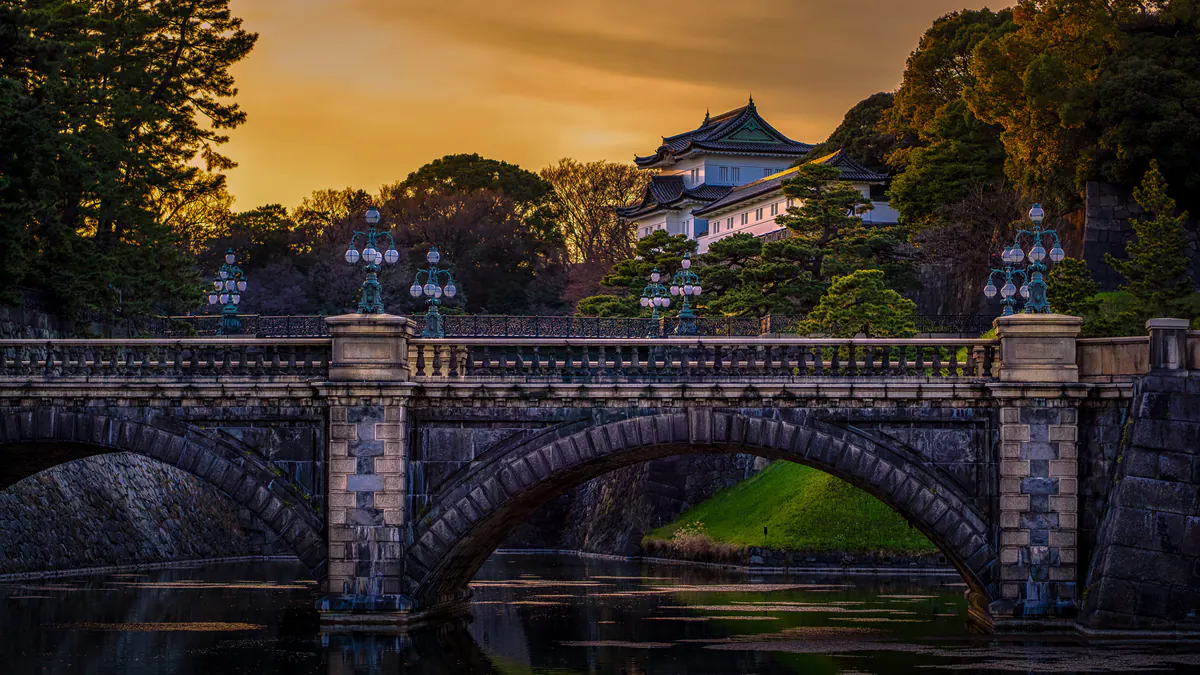
The classic view from outside the Main Gate combines a moat, an arched stone bridge, trees and the Fushimi watchtower beyond. It is a view of the palace setting and historic defenses, not a photograph of the Emperor's private house. The ceremonial palace buildings are largely screened by trees from this viewpoint.
You will often hear the whole scene called Nijubashi. Strictly speaking, the name refers to the iron bridge behind the stone bridge, rather than the stone arches in the foreground. You do not have to memorize the terminology to enjoy the view, but it explains why photographs and map labels can seem inconsistent.
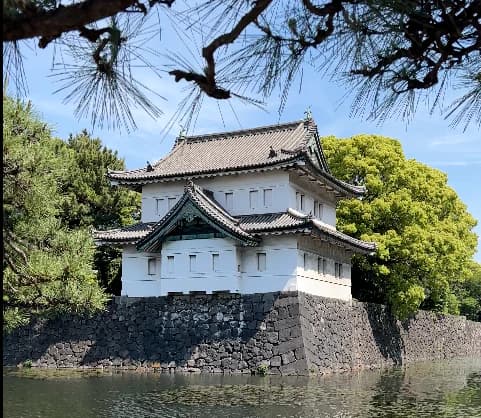
The cover photo of this article shows a historic watchtower above stone ramparts and a moat. That distinction matters: a turret, a ceremonial palace building and a private residence are not interchangeable subjects. When sharing your own pictures, describe the visible feature rather than labeling every white building the Emperor's house.
Visit the Imperial Palace East Gardens without a tour
The East Gardens are part of the wider Imperial Palace grounds, not a separate distant attraction. They occupy former Edo Castle areas and offer a self-guided visit without requiring a place on the official palace tour. Admission is free, and advance booking is not required for the gardens themselves.
Rather than expecting a grand residence at the end of a path, look for the old guardhouses, substantial stone defenses and the base of the former castle keep. The keep itself is not standing. The open Honmaru area and the more intimate Ninomaru Garden give the visit different rhythms: one is broad and spacious, while the other rewards slower attention to planting and water.
For a first visit, enter at Ote-mon, spend time with the gate and guardhouses, then choose whether to explore the Honmaru and castle-keep base before returning through the Ninomaru area. Do not rush straight through simply to collect another landmark. The value here is understanding the scale of the former castle and enjoying a quieter part of central Tokyo.
Keep the route shorter if your group is tired or the weather is uncomfortable. You do not need to complete every path for the visit to be worthwhile. Check the gate map before choosing a different exit, especially if your next stop or station is on the opposite side.
East Gardens opening hours and closed days
The East Gardens usually close on Mondays and Fridays, with national-holiday exceptions. A Monday holiday can move the closure to Tuesday; February 23 is excluded from the usual holiday opening exception. They also close December 28-January 3 and may close for official functions. Check your actual date rather than assuming a weekend or holiday guarantees entry.
All seasonal opening periods begin at 9:00 a.m., with last entry 30 minutes before closing:
- March 1-April 14: closes 5:00 p.m.; last entry 4:30 p.m.
- April 15-August 31: closes 6:00 p.m.; last entry 5:30 p.m.
- September 1-30: closes 5:00 p.m.; last entry 4:30 p.m.
- October 1-31: closes 4:30 p.m.; last entry 4:00 p.m.
- November 1-end of February: closes 4:00 p.m.; last entry 3:30 p.m.
Check the official East Gardens visitor information and calendar before setting your route.
Can you go inside the Imperial Palace on a guided tour?
You can enter a controlled section of the palace grounds on the free official guided tour, but not tour residential rooms or palace interiors. The route includes historic features and the area outside ceremonial palace buildings. This is the better choice if you want more than the public exterior viewpoint and are happy to follow a fixed group route.
Tours normally start at 10:00 a.m. and 1:30 p.m. and finish about 75 minutes later. They generally do not operate on Sundays, Mondays, national holidays other than Saturdays, December 28-January 4, or afternoons July 1-September 30. Official functions can cause further changes.
Use the official palace tour calendar and application system for an advance place. Same-day places are limited and distributed at Kikyo-mon Gate, normally from 9:00 a.m. or 12:30 p.m. Bring valid original identification; a photocopy is not accepted. For an overseas visitor, carrying your passport avoids relying on whether another document will be accepted.
Read your confirmation carefully and allow time for registration and security. A stated tour start is not the time to arrive at the station. If you miss out on a place, use the exterior walk or East Gardens as an alternative when open, rather than assuming another gate can admit you to the same tour.
Can you take photographs at the Tokyo Imperial Palace?
There is no useful blanket answer of no photography anywhere. Ordinary personal photographs of permitted public views and garden scenery are different from entering restricted grounds or photographing where a sign or staff member prohibits it. Keep to the visitor route, respect barriers and follow the instructions for the specific area.
The private residence is not a public photo stop. Do not try to find a way around screens, fences or security restrictions. Seeing published photographs of palace buildings does not create public access to the Imperial Family's home.
Personal sightseeing photography should also not be confused with commercial or editorial production. The East Gardens have separate photography and filming permission rules (Japanese), and revenue-oriented filming is restricted. If you are planning a sponsored shoot, a monetized video or other business use, check the official rules before filming rather than assuming a normal visitor's permission covers it.
Choose the entrance before choosing the station
For the East Gardens, Ote-mon is a straightforward first-visit entrance: allow about five minutes on foot from Otemachi Station or around 15 minutes from Tokyo Station, depending on your exit and pace. The gardens also have Hirakawa-mon and Kitahanebashi-mon gates. Use the gate name in navigation, not a generic pin in the middle of the palace grounds.
For the public Main Gate and bridge viewpoint, plan around the Kokyo Gaien side; Nijubashimae Station is useful for this part of the visit. For the official tour, follow the instructions for Kikyo-mon instead. These names refer to different access points, not interchangeable entrances to the same attraction.
You cannot simply walk through the East Gardens into the official tour's meeting area. If combining them, leave the gardens and walk around outside to Kikyo-mon. Include this transfer and the required check-in buffer in your schedule rather than placing the two visits back to back.
A simple Imperial Palace plan for your Tokyo itinerary
With less than an hour: choose the exterior bridge-and-moat walk rather than trying to squeeze in both the gardens and a tour. Start from the station that suits your onward journey, enjoy the public viewpoint, then continue toward Marunouchi for food or a break. Leave the gardens for a day when you can visit without watching the clock.
With a relaxed morning: enter the East Gardens at Ote-mon, explore a manageable loop, and return toward Otemachi or Marunouchi for lunch. If you want the exterior bridge view as well, treat it as a separate walk with additional time. Keep the afternoon nearby in Ginza, Hibiya or another central district rather than adding multiple distant, timed attractions.
With a confirmed official tour: make that booking the anchor of the day. Add your actual meeting time, gate, identification reminder and travel buffer to the itinerary. Keep lunch or the next paid activity flexible enough that a queue or a slower walk does not put the rest of your day under pressure.
Use our interactive Japan map to compare the palace-area pins with nearby stops, then put your chosen route into the itinerary planner. For a wider visit, our things to do in Tokyo guide helps you choose complementary activities instead of turning one garden morning into a cross-city race.
Weather, walking and seasonal expectations
This is primarily an outdoor visit. Bring water, sun protection and comfortable shoes in hot weather, and do not treat a garden visit as an indoor rain alternative. Open lawns and broad exterior paths can feel very different from a shaded neighborhood street. In winter, the earlier garden closing time makes a late-afternoon arrival less useful.
For mobility needs, check the official access map and the specific route before committing to a full loop or fixed tour. Distances, slopes, gravel and time spent standing matter more than a simple claim that the palace area is easy to visit. Choose a shorter route and a suitable exit when necessary.
Seasonal planting can make the same grounds feel very different across the year, but no single visit guarantees a particular flower display. The wider palace area includes several distinct gardens and moats; a photograph tagged Imperial Palace cherry blossoms may have been taken elsewhere around the perimeter rather than inside the East Gardens. Match the actual location to your plan.
Tokyo Imperial Palace visiting questions
Is the Imperial Palace free? The East Gardens and official guided palace tour are free. A private walking-tour service is a separate purchase, not a compulsory palace admission fee. Check any additional museum or event separately rather than assuming it is included.
Can you visit without a reservation? You can visit the East Gardens without advance booking on open days, and enjoy permitted exterior viewpoints without joining the official tour. The tour has an advance application system and limited same-day places; walking up does not guarantee entry.
Can you see the Emperor or his home? A normal visit does not include a meeting with the Emperor or access to his private residence. Special public appearances are separately announced events with their own arrangements, not something included in a standard tour.
Is it worth visiting if you cannot go inside? Yes, if you enjoy gardens, castle history, stone defenses or a quieter central-Tokyo walk. If your priority is richly furnished interiors or a surviving castle tower, adjust your expectations. A short exterior stop may suit you better than a long garden visit.
Is this the same as the Kyoto Imperial Palace? No. They are different sites in different cities, with different visiting arrangements. Do not apply Kyoto's admission rules or photographs to your Tokyo plan.
Travel details can change. Confirm current schedules, opening hours, reservation rules, prices, and entry requirements with the relevant official provider before booking or traveling.
Related Japan Planning Articles
Tokyo · Activities · Trip Planning
Things to Do in Tokyo: Sights, Food, and Days That Fit Together
Trip Planning · Travel Tips · Transportation
Planning a Japan Trip for 2027: Changes, Dates, and Essential Tips

Travel Tips · Trip Planning · Activities