
Planning a Japan Trip for 2027: Changes, Dates, and Essential Tips
Plan your 2027 Japan trip with the changes that matter: shopping refunds, flight rules, hotel taxes, entry requirements, major events, and a practical booking checklist.
Affiliate disclosure: Some links in this article may earn Japan Trip Planners a commission at no extra cost to you. Recommendations are included when they are genuinely useful for planning, and you should still compare current prices, terms, and official provider information before booking.
What should you know before planning a Japan trip for 2027?
A Japan trip in 2027 can be extraordinary: neighborhood restaurants, mountain scenery, regional festivals, quiet gardens, and cities that reward exploring beyond the first famous stop. The challenge is not finding enough to do. It is building a trip around current information rather than a packing list, price estimate, or entry-rule video from several years ago.
The most important updates concern shopping refunds, travel taxes, airline policies, and a few major events. Several changes took effect in 2026 but will shape a 2027 holiday. Others are still proposals or future implementation targets. Those are not the same thing, and treating every announcement as an active rule can lead to unnecessary spending or incorrect paperwork.
This guide was checked on October 17, 2026. It covers the main issues a leisure traveler should plan around, not every nationality-specific immigration condition or every local regulation. Recheck the rules attached to your passport, airline, accommodation, and activities before paying nonrefundable costs and again shortly before departure.
- Confirmed for 2027 planning: the November 2026 tax-free refund transition, revised departure tax, existing local hotel-tax changes, and published major-event dates.
- Needs a later check: individual airlines' 2027 battery limits, local festivals, attraction booking windows, seasonal transport, and Mount Fuji climbing arrangements.
- Not a confirmed 2027 requirement: JESTA under the currently announced fiscal-2028 implementation target.
Tax-free shopping in 2027: pay first, then obtain the refund
For purchases from November 1, 2026, Japan is moving eligible tourist tax-free shopping to a refund method. Expect to pay the tax-inclusive price first, complete the shop's tax-free procedure, and receive the refund after Customs confirms the goods are leaving Japan. Ask the retailer how to register your refund method; payment routes and refund timing can differ.
Customs confirmation must take place when departing within 90 days of purchase. The reform removes the general-goods/consumables distinction, special consumable packaging, and the ¥500,000 consumables cap. The ¥5,000 minimum before consumption tax remains; do not combine unrelated shops' purchases to assume eligibility.
Do not consume the souvenirs you intend to claim. Unsealed packaging does not make food or cosmetics used in Japan refundable. If even one item in a purchase record cannot be presented, the other goods on that record can also lose eligibility. A useful precaution is paying separately for items you will use in Japan and souvenirs you will take home.
Complete the departure procedure before handing over baggage containing the goods. For a domestic-to-international connection, ask the airline and Customs how to keep purchases accessible at the final departure airport. Allow extra airport time, keep receipts, and follow the retailer's refund instructions. The official traveler leaflet explains the new flow and the receipt-level inspection rule.
Budget for the revised departure tax, not an old ¥1,000 estimate
Japan's International Tourist Tax increased to ¥3,000 per departure from July 1, 2026. Carriers generally collect it through the ticket price, not a separate airport cash payment. Certain transport contracts concluded before that date retain the ¥1,000 rate; exemptions include children under two. Check your fare breakdown rather than budgeting the same tax twice. See the official departure-tax notice for the effective date and exceptions.
This is separate from airport facility charges and hotel taxes. Two taxable passengers at the new rate account for ¥6,000 in departure tax, not ¥6,000 in total airline taxes.
Do not assume today's exchange rate will hold through 2027. Keep your working budget in yen and convert it at a current rate when comparing bookings. Refundable accommodation can be worth a slightly higher price while your route is still changing.
Hotel taxes: check Kyoto, Osaka, and Hokkaido carefully
Accommodation tax is local, not a uniform Japan-wide charge. It may be payable at the property after online prepayment. Confirm whether it is included, which accommodation-fee amount is taxable, and whether other compulsory charges apply.
Kyoto City, from March 1, 2026: the following bands are per person per night, not the whole party's room total.
- Accommodation fee under ¥6,000: ¥200 tax.
- ¥6,000-19,999: ¥400 tax.
- ¥20,000-49,999: ¥1,000 tax.
- ¥50,000-99,999: ¥4,000 tax.
- ¥100,000 or more: ¥10,000 tax.
Two taxable adults for three nights, each in the ¥6,000-19,999 band every night, would owe 2 × 3 × ¥400 = ¥2,400. Ask the hotel to confirm the calculation for meals, packages, children, or changing nightly rates. The official Kyoto rate notice replaces older three-band advice.
Osaka Prefecture: its September 2025 system charges ¥200 at ¥5,000-14,999, ¥400 at ¥15,000-19,999, and ¥500 from ¥20,000 per person per night; below ¥5,000 is untaxed. Hokkaido: its April 2026 prefectural tax is ¥100 below ¥20,000, ¥200 at ¥20,000-49,999, and ¥500 from ¥50,000 per person per night. Municipal taxes can be additional. This is not a complete nationwide tax list.
Entry requirements: your passport matters more than a generic travel video
Check entry rules for your nationality, passport type, trip purpose, and length of stay. Exemptions are not universal. Current arrangements generally allow U.S. passport holders short tourist stays within a 90-day exemption; Indonesian travelers face ePassport-registration conditions and a 15-day period, while Malaysia has a specified ePassport condition. Residence in another country does not confer its citizenship rights. Use Japan's official visa-exemption list and its footnotes for your passport.
Visit Japan Web supports immigration and Customs declarations. It is not a visa, an admission guarantee, or JESTA. Use the official service rather than a paid lookalike. Keep flight details, your first accommodation address, passport, and access to completed declarations available.
JESTA is not an announced 2027 requirement. At our October 2026 check, the Immigration Services Agency's published implementation target is fiscal 2028. Do not pay an unofficial fee or treat a proposed timetable as a current rule. Recheck official announcements before departure.
Flying to Japan: review power-bank rules again for January 2027
Battery rules are a reason to revisit an old packing list. JAL's current notice limits passengers to two power banks, each no more than 160 Wh, prohibits checking them in, and prohibits both recharging the bank from the aircraft and using it to charge another device onboard. It also asks passengers to avoid overhead-compartment storage. Protect terminals and keep the capacity label readable.
For January 2027, JAL warns the limit may fall to 100 Wh under anticipated IATA changes. That is not confirmation of an already universal rule. Check the current airline battery notice and every operating carrier on your itinerary, including codeshares and domestic connections. Verify any approval requirement before bringing a 100-160 Wh bank.
Charge devices before boarding and save essential documents offline. Check watt-hours, not just the mAh marketing number, and do not buy a large battery on the assumption that last year's allowance will apply.
Domestic flights: fare conditions changed, and airport connections still matter
ANA's Simple, Standard, and Flex domestic fares apply to departures from May 19, 2026. Current Economy conditions give Simple one checked piece up to 23 kg and seat selection from 24 hours before departure; Standard and Flex include two checked pieces up to 23 kg each and advance seat selection. Change conditions differ. Check the actual fare conditions, especially for domestic sectors attached to international tickets.
For Sapporo, Okinawa, or Kyushu, compare the whole journey: airport travel, bag drop, security, flight, baggage collection, and onward transport. Include paid luggage and terminal access, not just the advertised fare.
Haneda and Narita are separate airports. A transfer between them is not an ordinary terminal connection. Separately booked flights also need a clear missed-connection plan. If you finish in Kansai, price a Tokyo arrival and Kansai departure against the cost and time of backtracking. Our Japan airport transfer guide explains the main arrival options.
Two confirmed 2027 events worth checking against your route
GREEN×EXPO 2027: March 19-September 26, Yokohama. This International Horticultural Expo takes place at the former Kamiseya Communication Facility, not the Minato Mirai waterfront. Plan a separate outing and check the official event arrangements for access, visit-date reservations, shuttle services, and parking. A ticket does not necessarily complete every reservation step.
World Masters Games 2027 Kansai: May 14-30. Venues are spread across the region. Participants should choose accommodation around their actual sport and location. Other visitors should compare availability near venues instead of assuming everywhere is quiet after Golden Week. Check the organizer's event overview and sport-specific schedule.
Both events can add something distinctive to your trip. Neither proves that all of Japan will be crowded or expensive. For festivals, concerts, sports, and seasonal openings, wait for the relevant 2027 announcement before committing to an inflexible detour.
Tokyo Marathon and sumo: match the event to the city and date
Tokyo Marathon 2027 is scheduled for Sunday, March 7. Runners should follow official entry and race-weekend instructions. Sightseers should check event-day traffic and access notices before relying on a surface transfer through the course area. Use the official marathon site for the relevant arrangements.
The published 2027 Grand Sumo Tournament dates are:
- Tokyo: January 10-24.
- Osaka: March 14-28.
- Tokyo: May 9-23.
- Nagoya: July 11-25.
- Tokyo: September 12-26.
- Fukuoka: November 14-28.
Check the Japan Sumo Association calendar for each tournament's ticket-release date. A practice visit or demonstration package is not a Grand Tournament admission ticket. Match the city and dates to your route, and do not rearrange the trip around an unconfirmed purchase.
Japan's 2027 holiday calendar: dates that affect reservations
The official 2027 national-holiday calendar is published. Holidays can affect demand and hours, but do not mean every attraction closes.
- January-February: January 1 and 11; February 11 and 23.
- March: March 21, plus the substitute holiday on Monday, March 22.
- Golden Week: Thursday, April 29, and Monday-Wednesday, May 3-5. April 30 is not a national holiday; some travelers extend the break using leave.
- Summer: Monday, July 19, and Wednesday, August 11.
- Autumn: September 20 and 23; October 11; November 3 and 23.
September 20 and 23 are not one continuous national-holiday block. Obon, commonly around August 13-16 in many regions, is a separate family-travel period, not four nationwide public holidays. New Year can also bring closures beyond January 1. Confirm the actual business hours and travel arrangements for your dates rather than assuming the national calendar tells the whole story. Our Christmas and New Year guide covers that holiday's practical planning issues.
Choose a season without relying on a guaranteed blossom or weather forecast
Japan is beautiful and distinctive throughout the year. Spring offers blossoms, summer brings festivals and greenery, autumn adds foliage and harvest traditions, and winter has snow, hot springs, and illuminations. The right choice depends on your route and interests, not a claim that only one month is worthwhile.
Do not build the trip around a guaranteed 2027 blossom peak. Exact flower and foliage timing remains uncertain, including after forecasts appear. Choose places you would enjoy even if the season shifts.
Allow indoor breaks in hot weather and recovery time around typhoon-sensitive island travel or winter flights. Follow local warnings rather than protecting an unsafe booking. Our best time of year to visit Japan guide gives the fuller seasonal comparison.
Trains and passes: check the current product, not an old voucher tutorial
A format change is not always a discontinued product. The paper JR West Kansai Area Pass retired, but the digital WEST QR Kansai Area Pass continues. For 2027, verify the actual pass, eligible routes, activation, phone requirements, and seat-reservation process instead of following an old voucher tutorial.
Choose your route first. A Tokyo-Kyoto-Osaka trip does not automatically justify a nationwide pass, and private railways can create uncovered costs. Use our JR Pass calculator to compare relevant journeys, then check the regional rail-pass guide for product differences. An IC card or bank card is not automatically a reserved Shinkansen ticket.
Plan suitcase storage alongside seat reservations. Follow your operator's current baggage rules and recheck train times when the applicable timetable is released. A saved departure time is not a guaranteed 2027 service.
Mount Fuji and popular attractions: know what is not confirmed yet
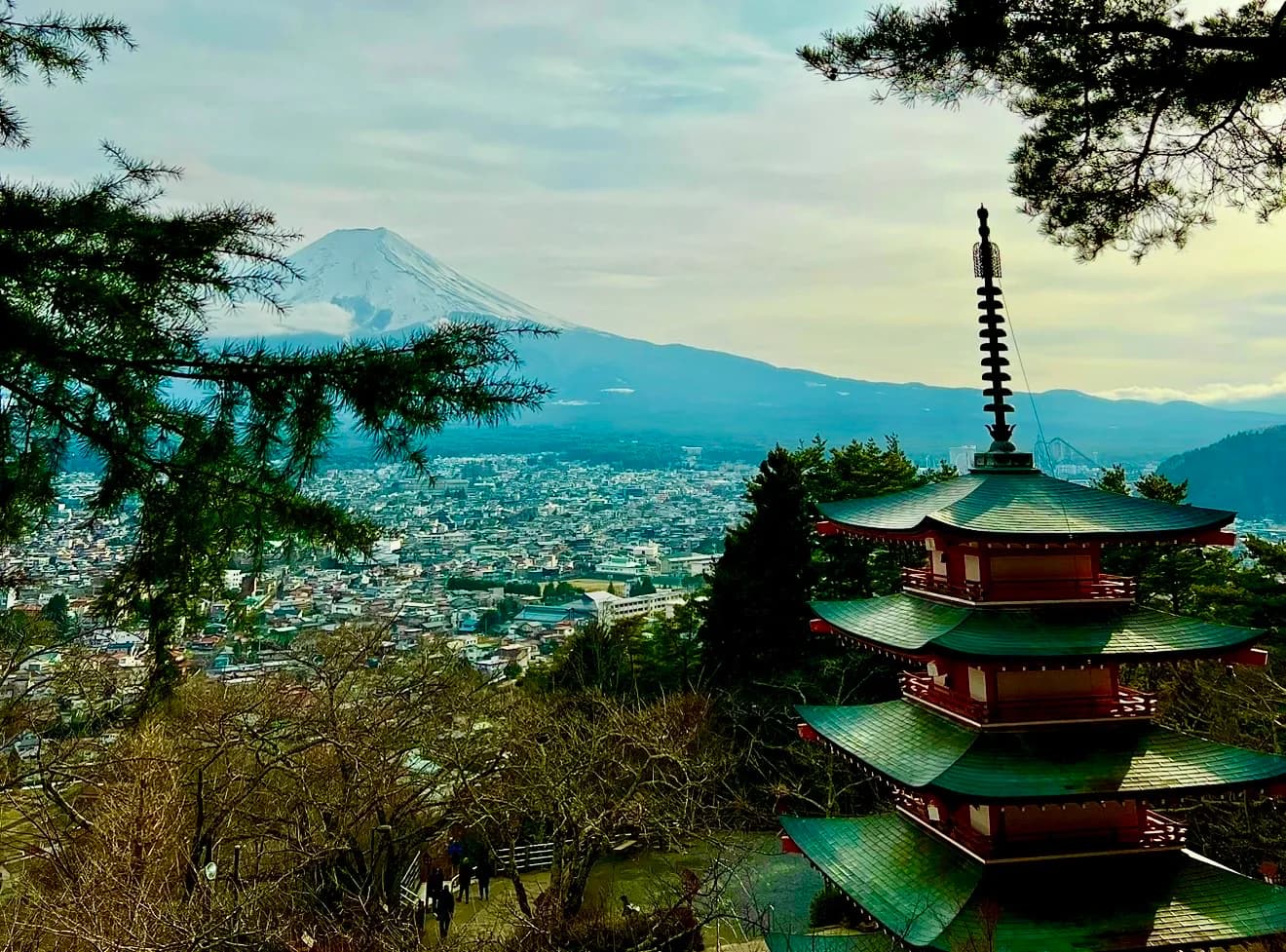
A Fuji viewpoint visit is not a summit climb. Lake Kawaguchi and Chureito Pagoda, shown in our photograph, are different outings from a high-altitude climbing route. At our October 2026 check, the official climbing site reports the 2026 season has ended. Do not treat that season's fees, gate hours, quotas, or hut-release dates as confirmed 2027 arrangements. Wait for your trail's announcement and plan equipment and accommodation properly.
For Disney, USJ, Ghibli attractions, teamLab, and special exhibitions, distinguish admission from timed experiences, express products, and transport. A listing is not a guarantee of availability. Our attraction booking checklist explains how to avoid buying the wrong combination.
Anchor the route around two or three priorities, keep nearby alternatives flexible, and do not make an entire Fuji day depend on a promise of clear skies.
Culture and local access: respect the place beyond the photograph
The cultural preparation that helps most is practical: noticing whether a street is private, whether photography is allowed, whether shoes should come off, and whether your group is blocking someone's ordinary journey. A famous location is still a neighborhood, workplace, or place of worship. Popularity does not override a no-entry sign or an instruction from staff.
In Kyoto's Gion districts, some lanes are private and photography or access can be restricted. Do not describe all of Gion as closed to visitors, but do not treat every appealing alley as public. Never chase, touch, or obstruct geiko or maiko. For portraits or cultural experiences, choose an arrangement that explicitly welcomes participation rather than trying to turn a person's commute into an attraction.
Keep voices low on public transport, queue without blocking exits, and carry rubbish until you find an appropriate disposal point. Follow signs at temples and shrines; permission to photograph an exterior does not imply permission inside. For baths, ask about tattoo policies, private-bath options, and accessibility before booking rather than assuming every onsen has identical rules.
Tourism policy and crowd management are best understood through the specific restriction that affects your visit. Do not interpret a local private-road rule as evidence that an entire country does not welcome visitors. Use trains where they suit your route, avoid bringing large suitcases onto crowded local buses when a better option exists, and include less concentrated places without treating quieter communities as unregulated photo sets.
Medicines, insurance, and safety: check before the final packing week
A prescription from home does not establish that a medicine is legal to import. Check the ingredient, quantity, and form against the official personal-import guidance. For controlled substances, consult the Narcotics Control Department. Some medicines require advance permission or cannot be brought in; ordinary quantity allowances do not override these restrictions. Resolve questions before the packing week.
Check insurance against your actual activities: climbing, snow sports, driving, and remote-island trips may require particular cover. Read exclusions, medical and cancellation terms, and pre-existing-condition requirements.
Save important documents, your hotel's address, and your insurer's assistance details offline. Follow official warnings and local instructions. A responsible guide cannot predict a specific earthquake for your holiday dates; practical preparation is more useful than viral predictions.
A workable booking timeline for a 2027 Japan trip
Work backward from your departure rather than booking everything in the order it appears on social media. The following is a planning sequence, not a universal ticket-release calendar. Individual providers set their own sales windows, and an item that is not on sale yet is not necessarily sold out.
- Before committing: check passport and visa conditions, medication questions, school/work dates, the 2027 holiday calendar, and the two or three experiences that justify the trip.
- Once the route is plausible: compare complete flight itineraries, arrival and departure airports, luggage, accommodation taxes, and cancellation terms. Reserve difficult event-night or specialist accommodation when its actual sales open.
- As booking windows open: secure date-sensitive attractions, relevant trains or flights, special meals, and any climbing hut or event transport. Save confirmation status, cancellation deadlines, and Japan-time release times.
- About a month before: revisit rail-pass value using the settled route, check hotel arrival instructions, organize connectivity, and confirm assistance or accessibility arrangements directly with providers.
- One to two weeks before: recheck entry and airline rules, complete available arrival declarations, confirm medication documents, and download essential tickets and addresses.
- During the trip: follow weather and transport notices, keep refundable alternatives usable, and separate shopping you will consume from purchases intended for a tax refund.
- Before leaving Japan: verify the airport and terminal, keep refundable purchases accessible, complete the Customs procedure before checking baggage containing them, and leave time for ordinary check-in and security too.
What these updates change in a real Tokyo-Kyoto-Osaka plan
Imagine two adults considering a May 2027 trip, arriving in Tokyo and finishing in Osaka. First compare dates with Golden Week rather than simply searching 'May Japan.' If the route includes Kansai after May 14, check the World Masters Games venues near possible hotels. This does not mean rejecting May; it means pricing the actual dates and locations.
Next compare returning to Tokyo for the flight home with departing from Kansai. Include the extra train, hotel location, airport transfer, luggage, and the value of the last sightseeing day. Add the correct Kyoto accommodation tax using the hotel's per-person fee calculation, and check whether the departure tax is already included in the flight quote.
Finally, if you buy souvenirs in Tokyo but leave from Kansai, retain access to them until the departure Customs procedure. Keep a Tokyo snack you intend to eat that afternoon on a separate transaction from refundable gifts. These small decisions can prevent a surprise cost or a rushed departure more effectively than adding another attraction to the calendar.
Bring the information together without overplanning every hour
Keep four lists beside the itinerary: confirmed reservations, items not yet on sale, policy checks with dates, and flexible alternatives. A collection of saved ideas is not yet a set of bookings, and marking the difference prevents expensive assumptions.
Explore nearby places and different prefectures on our interactive Japan map, then adapt prebuilt routes or build your own itinerary. Put flights, transfers, hotel moves, and recovery time in first. For budgeting and booking comparisons, our Booking Resources and free Money Savings Guide provide useful starting points.
A memorable 2027 trip does not require predicting every update. Understand what is confirmed, check what applies to you, and leave room to enjoy Japan.
Planning a Japan trip for 2027: quick answers
Do I need JESTA in 2027?
Not under an announced 2027 requirement at our October 17, 2026 check. The published target is fiscal 2028. Recheck official entry information before travel.
Does tax-free shopping disappear in 2027?
No. It changes to the announced refund method from November 1, 2026, with tax paid first and a refund after Customs confirmation if the conditions are met.
Are all the new charges foreign-tourist-only?
No. Departure and accommodation taxes have their own scope and exemptions. Avoid treating every tax as a foreign-visitor penalty.
Can I book everything now?
No. Sales windows and seasonal announcements vary. Mark items not yet on sale and recheck them rather than assuming they are sold out.
Should I avoid May 2027?
Not automatically. Price your actual dates against Golden Week and relevant Kansai event venues. A suitable route matters more than declaring one whole month good or bad.
Policy and event information checked October 17, 2026. Future announcements can change requirements, charges, access, and schedules. Confirm details with the responsible authority or provider before travel.
Travel details can change. Confirm current schedules, opening hours, reservation rules, prices, and entry requirements with the relevant official provider before booking or traveling.