
Best 2-Week Japan Itinerary to Buy for Tokyo, Kyoto & Osaka
Looking for a ready-made two-week Japan plan? See what the Tokyo and Kansai guide bundle covers, how the prebuilt Tokyo-to-Hiroshima route differs, and how to shape either into a trip that fits you.
Affiliate disclosure: Some links in this article may earn Japan Trip Planners a commission at no extra cost to you. Recommendations are included when they are genuinely useful for planning, and you should still compare current prices, terms, and official provider information before booking.
What is the best 2-week Japan itinerary to buy?
If your two-week trip is centered on Tokyo, Kyoto, and Osaka, the best purchase depends on whether you want destination guidance or a ready-filled calendar. For neighborhood ideas, sightseeing choices, and regional planning, the Tokyo + Kyoto and Osaka Guide Bundle is the closest fit because it covers all three cities. It is a pair of destination guides, not a fixed itinerary you follow hour by hour.
If you specifically want a prebuilt, day-by-day schedule, the closest match in our Premium route library is 14 Days Tokyo to Hiroshima. It includes Tokyo, Kyoto, and Osaka, then continues to Kamakura, Nara, Kobe, Hiroshima, and Miyajima. That wider route is a good starting point if those extra stops appeal to you; it may be too full if you want a slower trip focused only on the three major cities.
Our practical recommendation: buy the destination bundle if you want help choosing what to see in these cities, and use the itinerary builder to set the actual pace. Choose the prebuilt route when you want a complete schedule to adapt and are comfortable removing stops that are not right for your trip.
Should you buy a Japan travel guide bundle or a prebuilt itinerary?
These products solve different problems. A destination guide helps you choose places and understand how to visit a city. A prebuilt itinerary gives you a day-by-day schedule with activities and travel events already placed on the calendar. Neither one knows your flight times, hotel location, walking pace, budget, or must-do experiences until you adjust it.
The Tokyo + Kyoto and Osaka Guide Bundle is designed for people who want detailed ideas across the Tokyo area and Kansai. Use it to choose neighborhoods, attractions, day trips, and practical decisions, then organize your own dates and hotel nights. Check the bundle page for the current price and exact inclusions before purchase.
A Premium prebuilt route is better when you want a working schedule to edit instead of starting from an empty calendar. The current 14 Days Tokyo to Hiroshima route is marked Extended and uses all 14 calendar days to travel west through multiple destinations. Review its city list first: a two-week holiday does not automatically require six stops or a new hotel every few nights.
If you are still comparing the route itself, begin with our public 7-, 10-, and 14-day Japan itinerary overview. It explains how to distribute time before you decide whether a guide bundle or Premium route would make your planning easier.
How many nights should you spend in Tokyo, Kyoto, and Osaka?
For 14 calendar days with arrival and departure included, a useful starting split is five nights in Tokyo, five in Kyoto, and three in Osaka. That is 13 hotel nights. It gives you a light arrival day, one real transfer day between each base, and time to explore instead of counting the fastest train ride as a sightseeing day.
Days 1-5: Tokyo. Keep the arrival day flexible, group sightseeing by neighborhood, and choose no more than one major day trip unless you would rather spend that day in the city. Day 5 can be a slower day or an optional excursion, not an obligation to fit in both.
Days 6-10: Kyoto. Move to Kyoto and use it as a base for the city's different areas. Leave one day for a nearby outing such as Nara if it interests you, or use it to slow down in Kyoto. You do not have to change hotels to take every Kansai day trip.
Days 11-13: Osaka. Move to Osaka. Give the transfer day a simple evening, then use the next two days for the experiences you care about. One can be an Osaka neighborhood day; the other can be Nara, Universal Studios Japan, or a second Osaka day. Pick one anchor rather than stacking multiple full-day trips.
Day 14: departure. Depart from Kansai Airport if that matches your flight. If your international flight leaves from Tokyo, plan a return-to-Tokyo night before departure instead of relying on a same-day long-distance train connection to catch the flight. Adjust the hotel-night split to your actual ticket and hotel check-in dates.
What to check before you buy a preplanned Japan itinerary
Confirm what the product actually gives you. A digital guide, a printable route, a prebuilt itinerary calendar, and a travel package are not the same thing. Look for the number of included days, whether accommodations are included or merely suggested, what happens after purchase, and whether you can copy or edit the plan.
Check the overnight plan, not only the activity list. A polished route should make clear where you sleep each night, when you change hotels, and whether its day count includes your arrival and departure. If the route lists attractions from morning to night without explaining the transfers between cities, expect to edit it before relying on it.
Check geographic fit. Tokyo, Kyoto, and Osaka are different planning areas, and several famous sights inside each city may still require meaningful travel across town. Activities close together on a map are not always quick to reach on foot or by train. A good schedule groups places by area and leaves a buffer for stations, meals, check-in, and fatigue.
Finally, judge the pace against your own group. A route labeled Extended, fast-paced, or immersive may be exciting for someone who likes full days and frequent moves, but uncomfortable for another traveler. Look for optional stops and a way to remove days or destinations without breaking the whole plan.
Make the route fit your trip, not the other way around
Everybody's trip is unique. Two travelers can have the same dates and three cities but need different plans because they arrive at different airports, travel with different people, or care about different things. Families may need shorter days and easy hotel access. Museum fans may want a timed reservation and fewer stops nearby. Food-focused travelers may prefer extra evenings in Osaka, while history lovers may trade a shopping day for a nearby historical site.
Start with fixed commitments: flight dates, booked hotels, timed-entry tickets, mobility needs, and one or two things each person most wants to do. Add city-change days next. Only then fill the open time. Put optional ideas in the itinerary rather than treating every saved place as a promise to visit.
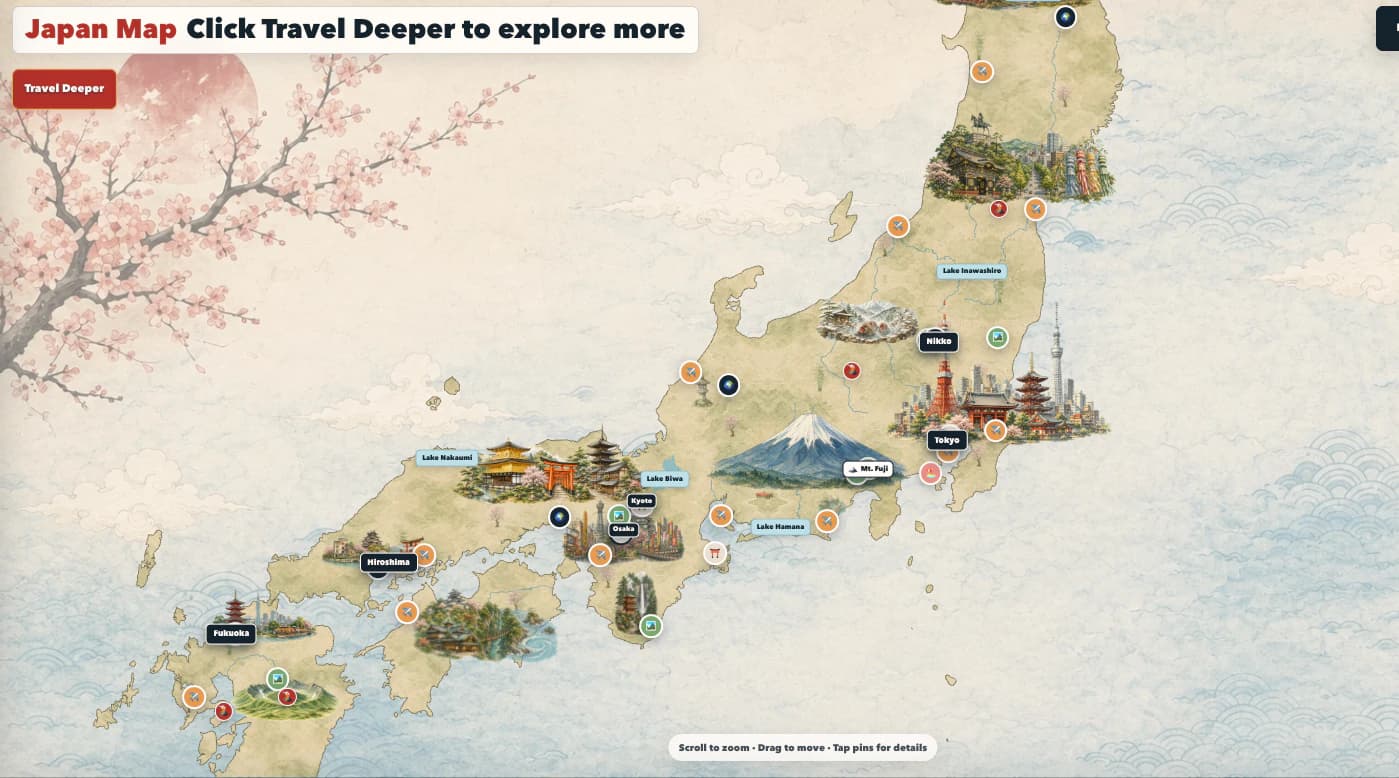
Use the interactive Japan map to see which pins belong together before assigning them to a day. Then use the itinerary builder to organize your own dates, hotels, activities, and transportation. Browse the Premium prebuilt route library for sample schedules and ideas; duplicate a route to make a separate plan you can tailor. The goal is not to copy someone else's trip exactly. It is to borrow the parts that make yours easier to plan.
For a more detailed sample of what arrival days, hotel nights, and transfers look like, see our 10-day first-time Japan itinerary. It is a different trip length, but the route-planning principles scale to two weeks.
Questions about buying a 2-week Japan itinerary
Is the Tokyo + Kyoto and Osaka bundle a day-by-day itinerary? No. It includes destination guides for Tokyo and Kyoto/Osaka. Use them for ideas and planning guidance, then build your calendar in the itinerary builder.
Does the 14 Days Tokyo to Hiroshima route include Tokyo, Kyoto, and Osaka? Yes. It also continues through additional stops including Kamakura, Nara, Kobe, Hiroshima, and Miyajima. Review the route before choosing it, because its extended pace may not suit someone who only wants the three cities.
Is 14 days enough for Tokyo, Kyoto, and Osaka? Yes, if that means 14 calendar days including arrival and departure. It leaves enough time for all three with realistic hotel moves and some flexible time. Two weeks does not require adding another region.
Should I stay overnight in both Kyoto and Osaka? It depends on the experience you want and your airport. Staying in both can make evenings and local outings easier, while using one Kansai base avoids a hotel move. Compare the door-to-door journeys and the final airport transfer before deciding.
Do I need a nationwide rail pass for this route? Do not buy one just because you are visiting several cities. List the actual trips first, then compare current ticket and pass coverage using our JR Pass calculator.
Start with a strong plan, then make it yours
A good two-week Japan itinerary is not the one with the most destinations or the most prefilled activities. It is the one that uses your days well and leaves you enough energy to enjoy them. Choose the guide bundle for city-specific ideas, the prebuilt route library for a day-by-day starting point, or combine them if that matches how you like to plan.
Explore the destinations, check the geography on the map, and organize the parts that matter in your itinerary builder. Keep the parts that fit, delete the parts that do not, and leave room for the places you discover along the way.
Travel details can change. Confirm current schedules, opening hours, reservation rules, prices, and entry requirements with the relevant official provider before booking or traveling.