
How Does Japan's Trash and Recycling System Work?
A practical guide to sorting trash and recycling on your Japan trip.
In this article
Affiliate disclosure: Some links in this article may earn Japan Trip Planners a commission at no extra cost to you. Recommendations are included when they are genuinely useful for planning, and you should still compare current prices, terms, and official provider information before booking.
The short answer: sort locally and carry your own litter
Japan's trash system works through separate collection streams: ordinary residual rubbish, recyclable materials, and items requiring special handling. However, the categories, collection days, bags and preparation instructions depend on the municipality. Even within Tokyo, a guide for one ward is not automatically the right guide for another.
For most travelers, the useful approach is much simpler than memorizing a resident's collection calendar: read the labels on the bin in front of you, keep drink containers separate from food waste, and ask your accommodation how it handles rubbish. When there is no suitable bin, carry your litter until you can dispose of it appropriately.
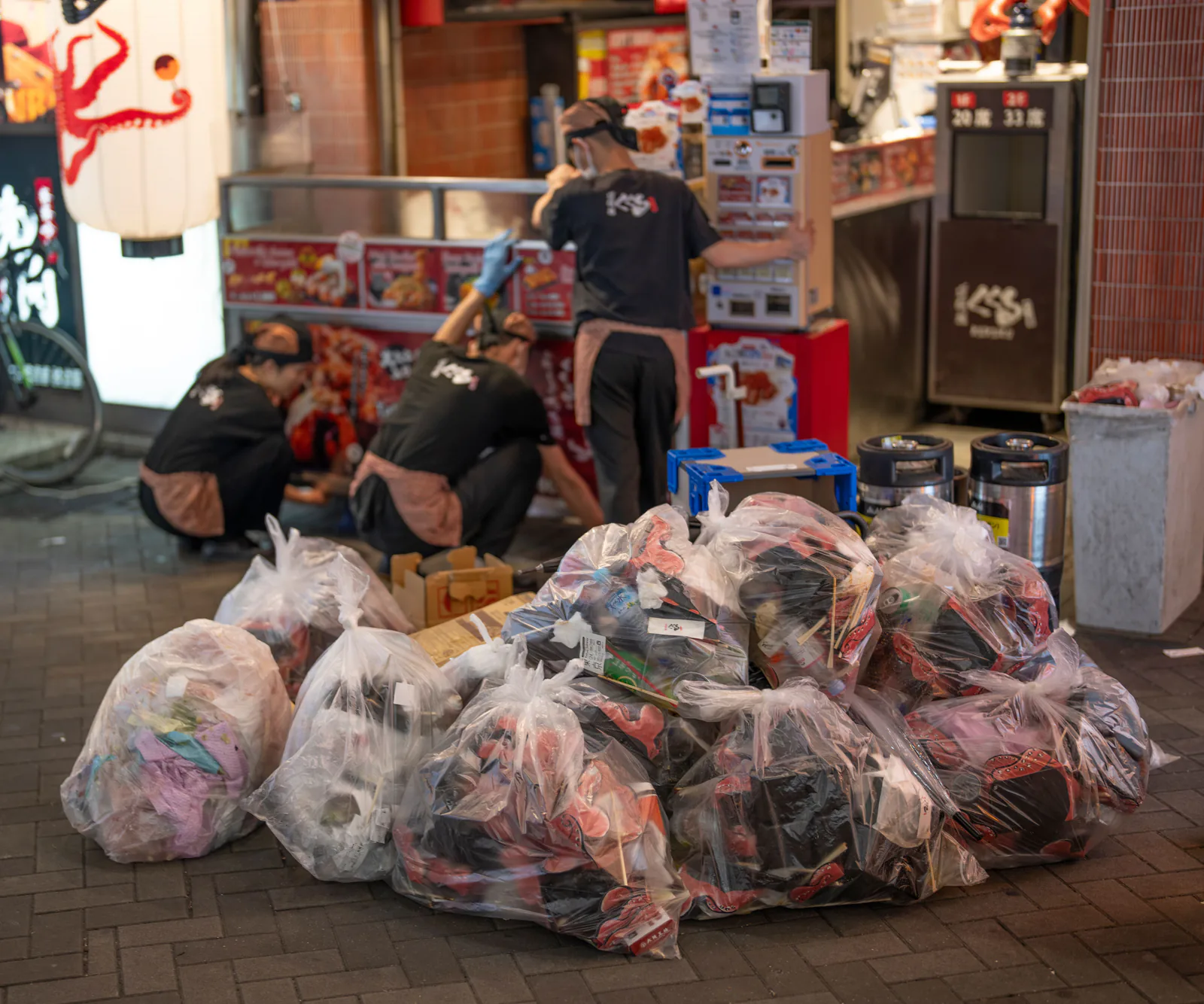
This guide explains the patterns you are likely to encounter, not a replacement for the instructions at your actual address. A hotel, holiday rental and restaurant may also use different collection arrangements. The restaurant scene in our cover photo should not be treated as a diagram of household sorting or permission to leave bags on the street.
Where can tourists throw away trash in Japan?
Public bins can be limited. Do not assume the next intersection, station entrance or park will have a general rubbish bin. Carry a small, leak-resistant bag in your daypack, with a separate space for empty bottles or cans. That turns an inconvenient search for a bin into something you can deal with at your next proper stop.
When buying a snack, look for the seller's disposal instructions before walking away. Some food stalls, shops and eating areas provide bins for their customers' packaging; others do not. Ask staff if you are unsure. A business's bin is not automatically a public service for rubbish brought from elsewhere, and making a small purchase does not override a sign restricting its use.
At stations, shopping centers and attractions, use bins that are actually provided for visitors and follow their labels. Do not open cupboards, go behind counters or assume every bin beside a building is public. If a bin is full, keep your rubbish rather than leaving a bag beside it.
Back at your accommodation, use the designated guest bins or ask reception where to put your day's litter. This means normal travel rubbish, not an unlimited right to abandon possessions or leave oversized items behind.
The main trash and recycling categories you will see
Think of these as common category names, not a universal checklist. Bin colors and accepted materials vary. Where a bin displays pictures of accepted items, use those pictures alongside the wording rather than choosing a bin only because it has the recycling symbol.
- Burnable or combustible rubbish: often includes food scraps, used tissues and other non-recyclable everyday waste. The local guide decides which additional materials belong here; burnable does not mean anything that could physically catch fire.
- Non-burnable or incombustible rubbish: may include certain metal, ceramic or glass items. A drinking glass is not automatically collected with glass bottles, and sharp or broken items need the local preparation method.
- PET bottles: a collection stream for eligible plastic bottles, commonly drinks bottles. A takeaway plastic cup is not a PET bottle simply because it is transparent.
- Cans and glass bottles: sometimes collected together and sometimes separately. Check whether the bin accepts both and whether it is specifically for beverage containers.
- Plastic resources: may include packaging alone or a broader range of eligible plastic products. Dirty packaging, mixed materials and battery-powered products need particular care.
- Paper and cardboard: clean, accepted paper can have a separate collection route. Used tissues, greasy food paper and coated packaging should not automatically join clean paper recycling.
- Special or bulky items: batteries, certain electronics, spray cans and large unwanted possessions have separate instructions. Do not choose a general bin just because the item fits through its opening.
How to recycle a plastic drinks bottle, can or glass bottle
Start by finishing or appropriately emptying the drink. Do not put a bottle containing liquid into a recycling box, or use the bottle as a container for cigarette ends or other rubbish. Where you can prepare recycling at your accommodation, follow the instructions for rinsing, removing caps and labels, and keeping materials separate.
The bottle body, cap and label can be different materials. A PET collection stream does not mean all three should automatically go in together. Follow the local instructions for caps and labels, and any dedicated openings at a public collection point. Do not put them loose into a drink-container box unless that collection system specifically accepts them.
Crushing is a good example of why blanket advice fails. Kyoto City's household bottle-and-can guidance (Japanese) says not to crush cans or PET bottles because doing so interferes with sorting. It also allows its specified cans, bottles and PET bottles together in the appropriate designated resource bag. That does not mean a public three-bin unit elsewhere should have everything mixed together.
The box beside a vending machine is for accepted empty beverage containers. It is not the place for a lunch tray, coffee cup, convenience-store bag or food leftovers. Check the displayed materials even if the opening looks large enough for something else.
What about plastic wrappers, lunch trays and paper cups?
These are often harder than drinks bottles because the answer depends on both material and condition. Separate leftover food from packaging where instructed. A food container covered in sauce should not simply be dropped into clean recycling because a plastic mark appears on its base. Follow the property's instructions for cleaning or treating packaging that cannot readily be cleaned.
The plastic symbol identifies a material or packaging category; it is not a nationwide promise that every plastic item goes into the same bin. Some collection schemes accept eligible plastic products as well as containers and wrapping. Others have different scope or preparation requirements. A plastic-looking electric toothbrush, portable fan or disposable electronic device must not be treated as ordinary plastic packaging.
Kyoto is one example of a city that collects eligible plastic products alongside plastic containers and packaging. Older advice that all non-packaging plastic must go with burnable rubbish can therefore be misleading. Check a current municipal guide instead of relying on an old infographic saved before your trip.
For a takeaway coffee, the cup, lid, sleeve and remaining drink may need different treatment. Use the cafe's instructions or ask its staff before leaving. For paper shopping bags and cardboard souvenir boxes, keep clean paper separate when your accommodation offers paper recycling; remove non-paper inserts as directed.
Hotels and rental homes: follow the property's system
In a hotel, check the room's bin labels and any guest recycling point. If there is only one small bin, ask whether bottles and cans should be placed separately and where housekeeping wants them. Do not conclude that everything goes into one collection stream simply because one bin is visible in the room.
At a rental home, read the host's rubbish instructions when you arrive, not just before checkout. The property may have indoor sorting containers, a managed collection area or specific arrangements that are different from a neighboring home. Do not copy whatever bags you happen to see outside.
Ask four practical questions: which items go together, which bags are required, where the permitted collection point is, and when guests should put rubbish there. Also ask what to do if checkout falls before the next collection. Save the answer with your check-in instructions so everyone in your group follows the same plan.
Collection days are not permission to put anything out at any time. A bag left at the wrong point or on the wrong day may be rejected or create work for neighbors. Never take a rental home's accumulated rubbish to a station, convenience store or another property's collection point to avoid dealing with checkout instructions.
Do you need special garbage bags in Japan?
Sometimes, but there is no single Japan-wide answer. For municipal household collection, Kyoto City uses designated paid bags, including yellow bags for burnable rubbish and transparent bags for its resource streams. By contrast, Tokyo's Meguro Ward describes lidded containers or bags through which the contents can be seen for its burnable and non-burnable collection. These examples explain the variation; they are not instructions for every hotel or holiday rental in either city.
Privately collected accommodation or business waste can have different arrangements from municipal household collection. Do not buy a roll of bags based only on the city name if your host has supplied a different approved system. Equally, a bag that was correct at your first stay may not be suitable at the next.
Before a longer rental stay, ask the host to show you the actual bags and collection instructions. This is more useful than trying to decode an entire residential calendar while your group is checking out with packed suitcases.
Batteries, power banks, broken glass and unwanted luggage
A dead power bank is not ordinary rubbish. Batteries and products containing rechargeable batteries can cause fires when mixed into other waste and crushed during collection or processing. Keep them out of general rubbish and ordinary plastic recycling. Ask your accommodation to help identify an appropriate municipal, manufacturer or retailer collection route.
Do not assume a shop's battery box accepts every battery or damaged device. Swollen, damaged or overheating products need specific advice and may be excluded from ordinary take-back schemes. Stop using a product showing abnormalities, do not force out an embedded battery, and tell staff what the problem is rather than hiding it in a bin. Japan's Ministry of the Environment battery guidance (Japanese) directs people to their municipality's disposal rules for these items.
Broken glass, blades, aerosol cans and lighters also need item-specific instructions. Do not leave sharp pieces loose for housekeeping to discover, puncture a can based on generic advice, or put a partially full spray can into an ordinary recycling stream. Ask how the property wants the item handled.
If a suitcase breaks or you buy a replacement, arrange disposal before checkout. It may be treated as bulky waste with a booking and fee, while a hotel's commercial disposal arrangements may be different. Ask what the property can arrange and what it costs. Leaving luggage in the room or beside a public bin is not an appropriate disposal plan.
Does Japan recycle all its trash?
No. Separating rubbish does not mean every item becomes a new product. Recyclable streams are collected for sorting and processing, while other waste follows different treatment routes. In Tokyo's 23 wards, for example, combustible waste is incinerated, and heat from that process is used for electricity or heat supply. Ash and remaining residues still need further handling.
Material recycling and recovering energy from burning waste are not the same thing. Be cautious with a headline recycling percentage that does not explain which activities it includes. For a visitor, the useful contribution is to keep accepted recyclable materials free from food, liquid, batteries and unrelated rubbish, while following the actual local system.
Reducing unnecessary packaging also avoids work further down the chain. Carry a reusable shopping bag, decline disposable items you will not use, and choose a sit-down break when that suits your day rather than accumulating multiple takeaway cups and containers. These are practical options, not a requirement to make your trip perfectly waste-free.
An easy trash routine for a day of sightseeing
Before leaving your accommodation, put a small rubbish bag in your daypack and check where to return with bottles or cans. After a snack, deal with the packaging at the seller's designated customer bin if there is one; otherwise seal it away and continue your day. Keep empty drink containers separate so you can use a suitable collection point without sorting through food scraps on the street.
On a long train journey, look for the actual disposal instructions on the train or at your destination rather than assuming a particular carriage has a bin. On a hike, beach visit or temple walk, be prepared to bring everything back. A toilet bin is not a substitute for a general rubbish service, and packaging, wipes and food waste should not be flushed.
If you are uncertain at a bin, keep the item and ask later. You do not need to turn a sightseeing afternoon into a search for the perfect disposal point. A short stop back at your hotel or clear instructions from your host usually makes the rest of the day easier.
For the rest of your planning, our Japan travel and transport guide covers everyday journey decisions, while our guide to hotels, rental homes and ryokans helps you compare accommodation styles. Add check-in, checkout and useful host instructions to your Japan itinerary before travel day.
Common questions about garbage and recycling in Japan
Why can it be hard to find a trash can? Public bins can be limited and are not a guaranteed feature of every street or station. Rather than relying on a single explanation for the whole country, plan to carry small amounts of litter and use the facilities actually provided at your stops.
Can I put rubbish in a convenience-store bin? Only use the bin within the store's rules and accepted categories. It may be intended for that store's customers and packaging. Do not bring a bag of accommodation rubbish into the shop or assume all convenience stores offer the same facilities.
Is all plastic burnable in Japan? No. Some plastics have a separate recycling collection, and eligible materials differ by area. Neither all plastic is burnable nor all plastic goes in recycling is a safe nationwide rule.
Can I leave rubbish outside with other bags? Not unless your accommodation has confirmed that it is the correct collection point, day, time, bag and sorting method for your property. A nearby pile could belong to a business or a different building.
What should I do if I cannot work out the right category? Keep the item separate and ask accommodation staff or your host, showing the item or a photo of it. For a rental home, search the official city or ward website for its current sorting guide using the property's actual municipality, not just the nearest major city.
Travel details can change. Confirm current schedules, opening hours, reservation rules, prices, and entry requirements with the relevant official provider before booking or traveling.