
The Best Interactive Map of Japan for Your Trip: Is Premium Worth It?
Explore all 47 prefectures, learn how to turn a collection of pins into a realistic day, and decide whether the free Japan map or Premium is better value for your trip.
In this article
Affiliate disclosure: Some links in this article may earn Japan Trip Planners a commission at no extra cost to you. Recommendations are included when they are genuinely useful for planning, and you should still compare current prices, terms, and official provider information before booking.
Which Interactive Japan Map Should You Use?
If you are deciding where to go in Japan, start with the free Japan Trip Planners interactive map. It covers all 47 prefectures and lets you zoom from the country view down to individual places. If you are standing on a platform and need the next departure, check the station displays and railway operator. You don't need to pay for a map subscription to find your way around.
We built our map for the decisions that come before directions: Is this a half-day outing or an overnight stop? Which sights belong together? Is that place across a lake or on the same railway line as my hotel? Those answers matter more than the number of pins a map can show.
What Detailed Regional Coverage Actually Gets You
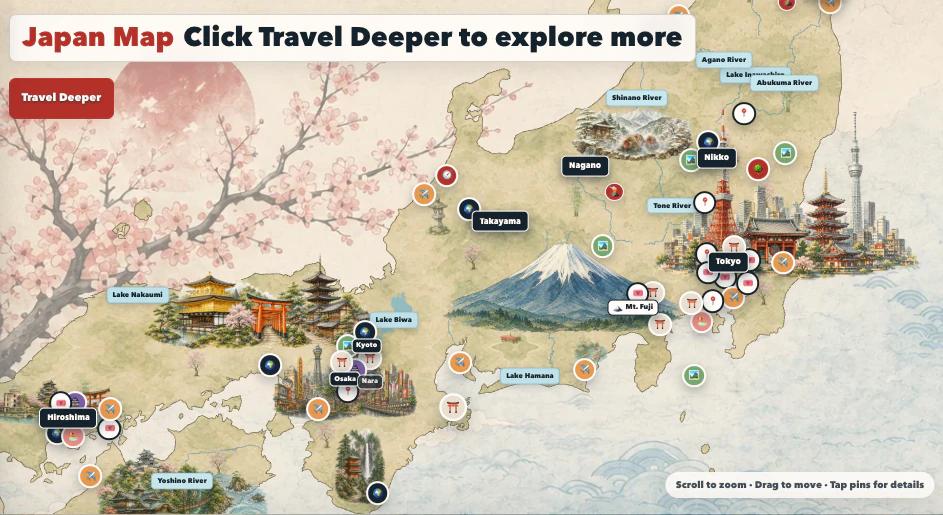
Our map covers all 47 prefectures, from Hokkaido to Okinawa. The country view gives you the big picture. Choose Travel Deeper in 2D to see the prefectures and open an individual map. Or switch to the free 3D view and zoom into a region for more local detail. Depending on the area, you can filter for cities, attractions, temples and shrines, castles, museums, parks, beaches and other public categories. Some place cards include photos, descriptions or booking options. Coverage varies by region and category.
The useful detail is not how many pins fit on the screen. It is seeing which places make sense together. A castle and its garden might share a stop; two places that look close at the national scale might sit on opposite sides of a lake. The map helps you spot that difference before you start comparing routes.
- Shiga: Search for Hikone Castle and Genkyuen Garden, then look at where Omihachiman sits along Lake Biwa. Castle and garden can form one outing; add Omihachiman only after checking the station-to-sight connections for both stops.
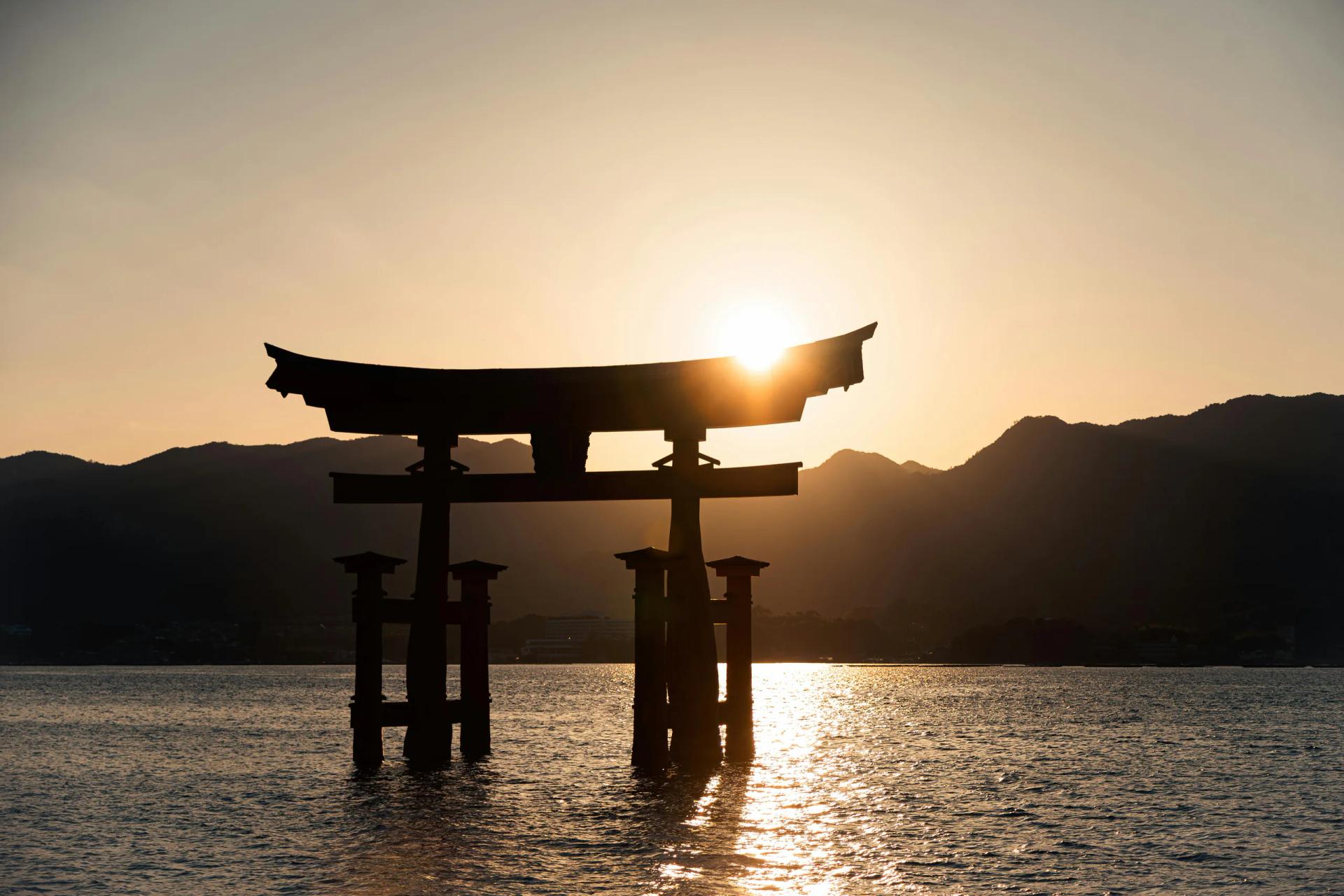
- Hiroshima: Compare the city sights with Miyajima across the water. A short-looking map distance still involves getting to a ferry pier, boarding, and walking on the island. Decide what you would cut if you want more island time rather than trying to fit everything in.
- Aomori: Compare Oirase Gorge with Lake Towada. The gorge is a route, not just one dot. Pick which stretch you want to walk, then check the starting and finishing stops and the last return connection before committing to the outing.
How to Use the Map During Your Trip
The night before, open the individual prefecture map and choose one main stop and one nearby backup. Turn on only the layers that help with that choice. If you're signed in, save the places you want to revisit. Save the destination's name and address in your navigation app as well, especially if your connection might be spotty.
In the morning, route from your actual starting point to the entrance, not just between two pins. For a ferry trip to Miyajima from Hiroshima, look up the mainland boarding point at Miyajimaguchi first. Then check the ferry operator's timetable and where you need to walk on the island. For a rural bus day, check the return trip before the outbound one. A great morning plan is not much use if the last bus back leaves before you finish.
For trains, check the departure time, direction, and train type. For large stations or step-free trips, verify the exit or accessible route against station information. The illustrated map and the 3D terrain are for orientation; they are not turn-by-turn directions, offline navigation, trail-safety guidance, or a live record of closures.
How To Turn Saved Pins Into A Day That Works
Start with the place you would be most disappointed to miss. In Tokyo, that could be a morning at Senso-ji. Open the Tokyo prefecture map and look at the stops around Asakusa before adding anything farther away. Kappabashi makes sense if kitchenware shops interest you, and Tokyo Skytree gives you a different kind of afternoon on the other side of the Sumida River. You don't need to add both. Pick the one that suits your group, then keep the other as a backup if plans change.
Next, check the trip from your hotel to your first stop and from your last stop back. A hotel near a major station isn't necessarily near the entrance you need, and the nearest pin isn't necessarily the quickest stop to reach. Compare door-to-door time, including walking, transfers and waiting. If you're traveling with children, luggage or anyone who needs a step-free route, check station exits and allow more time than the train ride alone would suggest.
Once you have two or three workable stops, give them time in your itinerary. Reserve the slot for anything with timed entry first. Put flexible walks, shopping and food around it instead of squeezing a reservation between cross-city transfers. If your plan is already tight, cut the optional stop with the most travel time. You can still keep it saved for another day.
Use the same process when moving between cities. An arrival day after an overnight flight is different from a full day in Tokyo. Mark the airport, accommodation and one nearby place you could visit after dropping your bags. Check the airport transfer and bag-drop arrangements before putting anything nonrefundable on the schedule. A short walk or meal near your hotel still makes a good first afternoon, even if your flight runs late.
Free vs. Premium: What Are You Actually Paying For?
The free map is enough to explore prefectures, search public pins, filter public layers and switch between 2D and 3D. You can sign in to save public places for later. There is no reason to subscribe just to zoom into Kyoto, look at a castle pin or get walking directions from another app.
Premium adds curated layers such as the restaurant database, onsen, sakura viewing, major stations and routes, and lesser-known locations. It also lets you create private map pins, useful for a hotel, meeting point or address that is not in the public catalog. The same membership adds planning tools outside the map, including more itinerary flexibility, prebuilt routes and online guidebook reading. Those extras are a reason to upgrade only if you expect to use them.
A Premium pin is a lead, not a reservation or a guarantee. An onsen may have day-use hours or access rules; cherry blossoms don't follow a fixed date; a station pin doesn't tell you which service is disrupted. The upgrade gives you more places to research, not a replacement for checking with the operator.
When Is a Japan Map Subscription Worth It?
For a first trip focused on a few major cities, start free. Try planning two days in the places you know you'll visit. If the public map gives you enough nearby options and your navigation app handles the trains, keep the money for the trip.
For a multi-region trip, Premium can be worth it if you keep running into a specific problem. Say you are comparing two towns for an onsen night, looking for lesser-known stops between bases, and want to mark your own hotels and pickup points. If those jobs come up across several days, the extra layers and private pins have a clear purpose.
At the time of writing, Monthly Premium is $9.99 USD before any applicable tax. For one trip, compare one month with what you would actually use during that billing period, rather than assuming you need an annual plan. Check the current price and renewal terms before starting. If all you need is one live route to your hotel, you do not need a subscription.
Our recommendation: pick one prefecture you are less familiar with and build a day using the free map. Choose an anchor stop, one nearby option and a realistic way back. Upgrade only if you can name the missing feature that would make the next few days easier to plan.
A Simple Way To Test The Value Before You Subscribe
Try planning a familiar day and a less familiar one before paying. For the familiar day, choose a city where you already know your main sights. Use the public pins to check how much backtracking your shortlist creates. For the less familiar day, pick a stop outside your usual route and see whether the public pins, your destination notes and the operator's information are enough to make a decision. The second day is the better test: it shows where you spend time when you don't already know the area.
Be specific about what's slowing you down. If you're trying to fit in an onsen, knowing there are more onsen pins is less useful than finding a few plausible stops along your route. Compare where they sit, whether you need a detour and how much time you can realistically give them. Then verify opening hours, day-use access and any rules that matter to your group. Premium helps you build the shortlist; the property still sets the terms.
Private pins solve a different problem. If you have booked a small ryokan, a pickup point or a meeting location that isn't in the public map, a private pin lets you keep it alongside the places you are considering. For a trip with several hotels, those fixed points can help you decide which attractions belong on a transfer day and which need a day of their own. If you have one hotel and a short list of easy city stops, you may not need that extra organization.
If you're planning with someone else, agree on what earns a place in the itinerary. A saved pin can be a maybe; a timed ticket, an early ferry or a hotel change is a commitment. Keeping those two lists separate makes it easier to shorten a day when everyone is tired without accidentally dropping the one stop you've already paid for.
Quick Questions About Japan Travel Maps
Does this map give live directions? No. Use it for discovering destinations and comparing places within a region. For turn-by-turn directions, use your device's navigation and verify time-sensitive details with the operator.
Do I have to pay to explore all 47 prefectures or switch to 3D? No. Both are part of the public map. With Premium, you're paying for our team's curated knowledge to make trip planning faster and easier: more places worth considering, more ways to compare them, and tools to fit them into your own route. You're not paying to unlock prefectures.
Can I rely on the map offline? Don't count on it. Before going somewhere with weak signal, save addresses, meeting points and relevant timetable screenshots, and download your navigation app's offline area where available. Don't assume an offline map will supply transit directions or disruption updates.
Explore the free map, see how the map controls work, or put your stops in the itinerary planner.
Travel details can change. Confirm current schedules, opening hours, reservation rules, prices, and entry requirements with the relevant official provider before booking or traveling.